
제이에스테크랩 설비
Electrode Resistance Meter
분류 Analysis
작성일 2026.01.15
조회 1490
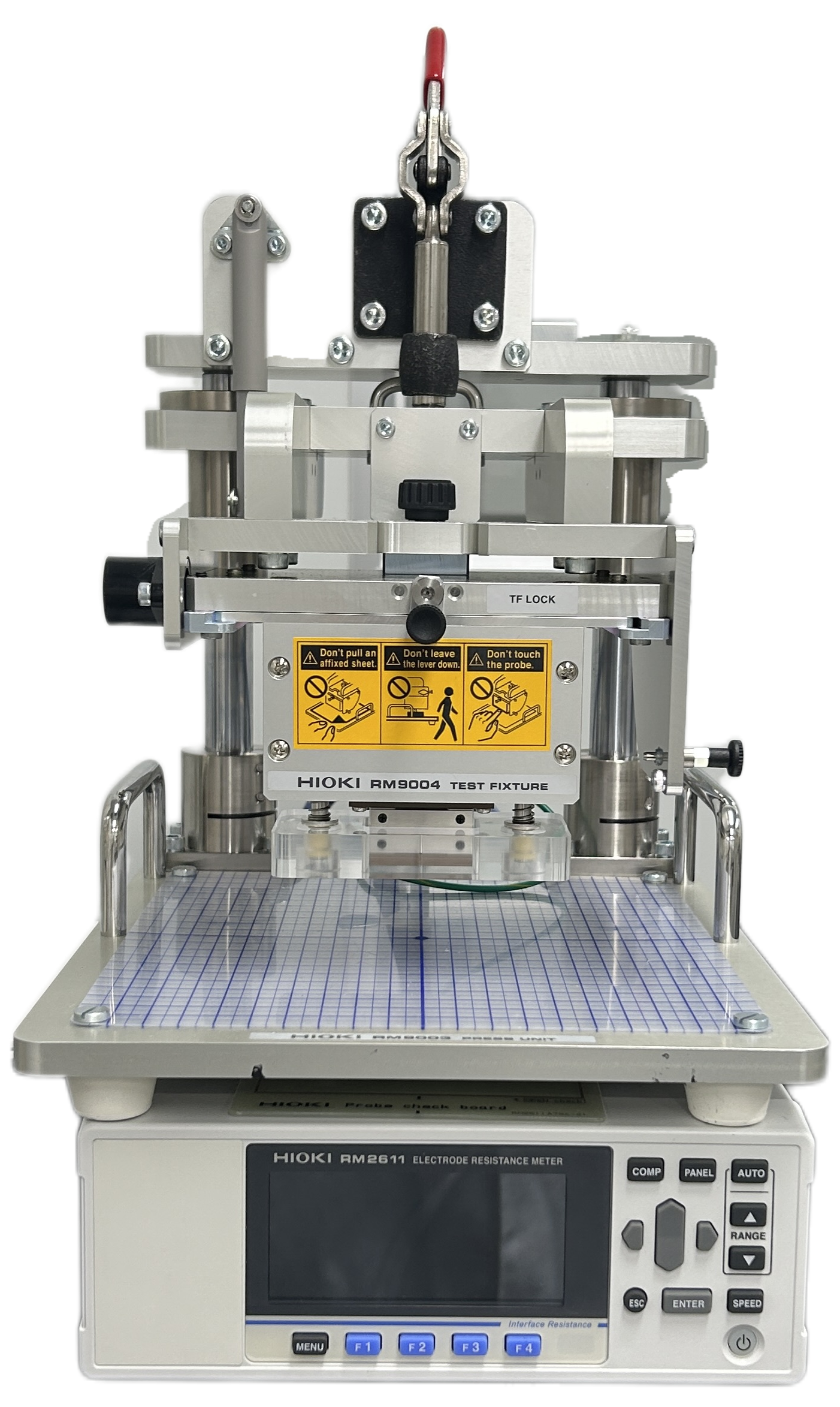
원리 및 기능
전극 소재나 전도성 샘플에 정확한 전기저항 또는 체적 저항률을 측정하기 위해 사용되는 장비이다. 일반적으로 4-point probe 또는 2-point probe를 이용해 전류를 흘리고, 그때 발생하는 전압을 정밀 측정하여 저항 값을 계산한다. 특히 4-point 방식은 전류 인가 단자와 전압 측정 단자를 분리하여 접촉저항과 리드선 저항의 영향을 제거하기 때문에, 분말 압정체, 박막, 벌크 전극 등에서 높은 정확도를 제공한다.
기기활용
- 전극 전도도 평가: 배터리 전극(활물질 코팅 전극, 집전체)의 시트 저항 및 전기전도도 분석, 전극 제조 공정(바인더, 카본 함량, 소결 조건)의 전도성 평가
- 박막·코팅층의 시트 저항 측정: 금속/산화물 박막, CNT/그래핀 코팅층, 투명전극(ITO 등)의 저항 균일성 검사, 표면 처리(도핑, 열처리, 플라즈마)의 효과 검증
- 분말 및 압정체 전기적 특성 분석: 분말 압축체(pellet), 소결체의 체적 저항률 측정, 촉매·세라믹·금속 산화물 등 고체 소재의 전기적 특성 비교
- 재료 개발 및 품질 관리(QC) : 새로운 전도성 소재(카본 복합체, 금속 나노입자, 도전성 폴리머) 개발 과정에서 전도성 지표로 활용, 공정 간 샘플 간 변동성 평가 및 품질 모니터링
- 측정 대상: 리튬이온전지용 양극·음극 전극 시트
- 측정 항목: 복합층 저항률 , 복합층–집전체 계면 저항
- 계산 방식: Finite Volume Method(FVM)을 이용한 전위 분포 역문제 해석
- 계산에 필요한 입력 정보: 복합층 두께(μm, 한쪽 기준), 집전체 두께(μm), 집전체 체적저항(Ω·cm)
- 측정 시간: 접촉 확인 + 전위 측정: 약 30초, 계산: 약 35초 (Intel i5-7200U 기준), (PC 성능 및 측정 대상에 따라 달라질 수 있음)
- 측정 전류: 1 μA ~ 10 mA
- 프로브 개수: 46개
Electrode Resistance Meter
Principle & Function
An electrode resistance meter is used to precisely measure the electrical resistance or volume resistivity of electrode materials and conductive samples. It typically applies current through either a 4-point probe or 2-point probe, and the resulting voltage is measured with high precision to calculate resistance.
The 4-point probe method provides particularly high accuracy because it separates the current-applying electrodes from the voltage-sensing electrodes, thereby eliminating errors caused by contact resistance and lead resistance. This enables accurate evaluation of pressed powder pellets, thin films, bulk electrodes, and other conductive materials.
Applications
• Electrode conductivity evaluation: Measures sheet resistance and electrical conductivity of battery electrodes (active-material coated electrodes, current collectors) and assesses conductivity changes related to binder content, carbon ratio, and sintering conditions
• Sheet resistance of thin films/coatings: Evaluates metal/oxide thin films, CNT/graphene coatings, and transparent electrodes (e.g., ITO) for resistance uniformity and the effects of surface treatments (doping, heat treatment, plasma treatment)
• Electrical characterization of powders and pellets: Measures volume resistivity of compressed pellets and sintered bodies; compares electrical properties of catalysts, ceramics, and metal oxides
• Materials development & quality control (QC): Provides key electrical indicators for developing new conductive materials (carbon composites, metal nanoparticles, conductive polymers) and monitors variability between samples for process control
Specifications
• Measurement target: Cathode/anode electrode sheets for lithium-ion batteries
• Measurement parameters: Composite-layer resistivity (Ω·cm), composite-layer–current-collector interfacial resistance (Ω·cm²)
• Calculation method: Finite Volume Method (FVM) inverse analysis of electric potential distribution
• Required input parameters: Composite-layer thickness (µm, one side), current-collector thickness (µm), current-collector volume resistivity (Ω·cm)
• Measurement time: Contact check + voltage measurement: approx. 30 s; calculation: approx. 35 s (Intel i5-7200U basis; varies with PC performance and sample type)
• Measurement current: 1 µA ~ 10 mA
• Number of probes: 46