
JS Tech Lab Facilities and Equipment
UV-vis-NIR
분류 Analysis
작성일 2026.01.15
조회 1600
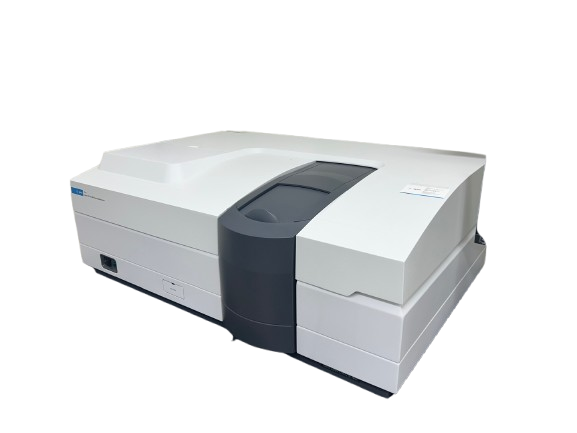
원리 및 기능
UV-Vis-NIR 분광법은 자외선(UV), 가시광선(Vis), 근적외선(NIR) 분광법을 결합하여 빛과 물질의 상호 작용을 연구하고 분석하는 기술이다. 이 기술은 자외선부터 가시광선, 근적외선 영역까지 일반적으로 190-2,500nm의 광범위한 파장을 포괄하고 있다. UV-Vis-NIR 분광법은 물질의 전자 및 분자 구조에 대한 통찰력을 제공한다.
기기활용
- 재료 광학 특성 분석: 반도체·코팅·광학 소재의 흡수·반사·투과 특성을 평가해 조성, 굴절률, 박막 두께 등을 파악
- 태양전지 품질 관리: 태양광 소재의 반사율·투과율을 측정해 효율성과 성능을 검증
- 나노물질 특성 분석: 금속 나노입자·양자점 등의 크기, 모양, 안정성, 광학적 특성을 분석
- 첨단 소재 연구: 밴드갭, 전자전이 등 광·전자적 특성을 측정해 신소재 성능 최적화에 활용
- Z-높이(Z-Height): 20 mm
- 광도 범위(Absorbance Range): 최대 8 Abs
- 광원(Light Source): 텅스텐 할로겐(Vis), 중수소 아크(UV)
- 스펙트럼 띠너비(Spectral Bandwidth):
- UV-Vis: 0.01–5.00 nm
- NIR: 0.04–20 nm
- 최대 스캐닝 속도(Max Scan Speed):
- UV-Vis: 2,000 nm/min
- NIR: 8,000 nm/min
- 측광 방식(Photometric System): 더블 빔(Double Beam)
- 파장 범위(Wavelength Range): 175–3300 nm
UV-Vis-NIR Spectrophotometer
Principle & Function
UV-Vis-NIR spectroscopy combines ultraviolet (UV), visible (Vis), and near-infrared (NIR) spectroscopy to analyze the interaction between light and matter. Covering a broad wavelength range—typically 190 to 2,500 nm—this technique provides insights into the electronic and molecular structures of materials. By measuring absorption, reflection, and transmission, it enables detailed optical and electronic characterization of a wide range of substances.
Applications
• Optical property analysis of materials: Evaluates absorption, reflection, and transmission of semiconductors, coatings, and optical materials to determine composition, refractive index, thin-film thickness, etc.
• Solar cell quality evaluation: Measures reflectance and transmittance of photovoltaic materials to assess efficiency and performance
• Nanomaterial characterization: Determines size, shape, stability, and optical properties of metal nanoparticles, quantum dots, and other nanostructures
• Advanced materials research: Measures bandgap, electronic transitions, and other optoelectronic properties for optimizing new material performance
Specifications
• Z-height: 20 mm
• Absorbance range: Up to 8 Abs
• Light sources: Tungsten-halogen (Vis), Deuterium arc lamp (UV)
• Spectral bandwidth:
- UV-Vis: 0.01–5.00 nm
- NIR: 0.04–20 nm
• Maximum scan speed: - UV-Vis: 2,000 nm/min
- NIR: 8,000 nm/min
• Photometric system: Double beam
• Wavelength range: 175–3300 nm