
JS Tech Lab Facilities and Equipment
FT-IR
분류 Analysis
작성일 2026.01.15
조회 1308
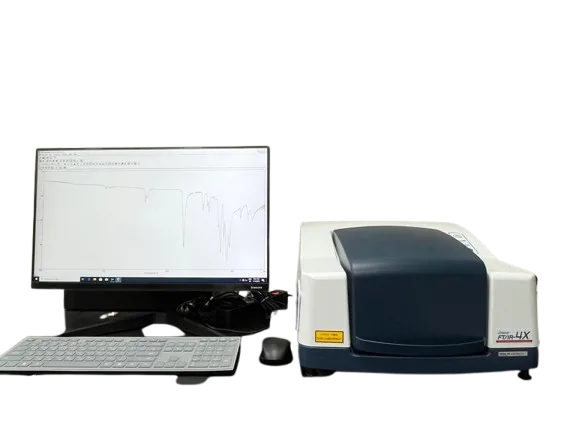
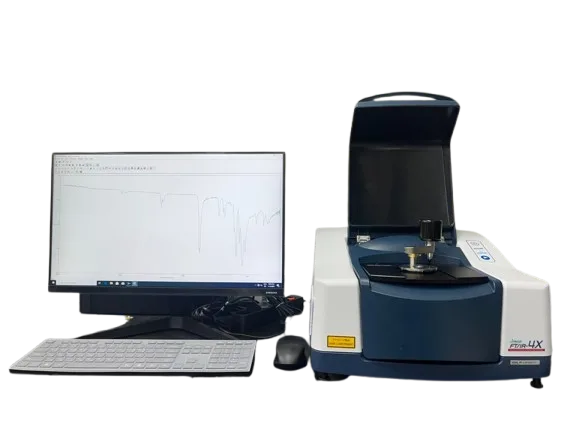
원리 및 기능
FT-IR은 물질이 적외선을 흡수할 때 나타나는 고유한 진동 에너지 패턴을 분석하여 화학 결합, 작용기, 표면 구조를 확인하는 장비이다. 인터페로미터를 이용해 얻은 신호를 푸리에 변환해 스펙트럼을 얻으며, 이를 통해 물질 식별, 결정성 변화, 불순물 검출, 표면 기능화 확인, 열처리·분해 과정 분석 등 다양한 연구에 활용된다.
기기활용
- 작용기 확인: 고유 흡수 피크를 통해 물질의 화학적 결합 특성 분석
- 합성 여부 및 반응 진행 확인: 전구체 소멸, 새로운 결합 형성 등 반응 전·후 스펙트럼 비교
- 불순물·잔존 용매 검출: 유기물·탄산염·질산염 등 예상치 못한 피크를 통해 오염 여부 판단
- 결정 구조 변화 모니터링: 열처리·소결·표면처리 전후의 결합 강도/진동수 이동 분석
- 중합체·바이오물질 분석: 고분자의 결합 구조 변화, 단백질의 2차 구조 평가
- 정성적 화합물 동정: 스펙트럼 라이브러리 매칭을 통한 물질의 정성 분석
- 표준 파수 범위: 7,800 - 350 cm⁻¹
- 옵션 파수 범위: 11,500 – 50 cm⁻¹
- 최대 분해능: 0.4 cm⁻¹
- 신호 대 잡음비: 35000:1
FT-IR (Fourier Transform Infrared Spectroscopy)
Principle & Function
FT-IR analyzes the characteristic vibrational energy patterns that occur when a material absorbs infrared light. These patterns provide information about chemical bonds, functional groups, and surface structures. Signals obtained through an interferometer are processed using Fourier Transform to produce spectra. FT-IR is widely used for material identification, monitoring crystallinity changes, detecting impurities, verifying surface functionalization, and analyzing thermal or decomposition processes.
Applications
• Functional group identification: Determines chemical bonding characteristics through characteristic absorption peaks
• Verification of synthesis and reaction progress: Confirms precursor consumption or formation of new bonds by comparing pre- and post-reaction spectra
• Impurity and residual solvent detection: Identifies unexpected peaks from organics, carbonates, nitrates, etc., to evaluate contamination
• Monitoring changes in crystal structure: Analyzes bond strength shifts and vibrational frequency changes before and after heat treatment, sintering, or surface modification
• Polymer and biomaterial analysis: Tracks changes in polymer bonding structures and evaluates secondary structures of proteins
• Qualitative compound identification: Performs qualitative analysis by matching spectra with spectral libraries
Specifications
• Standard wavenumber range: 7,800 – 350 cm⁻¹
• Optional wavenumber range: 11,500 – 50 cm⁻¹
• Maximum resolution: 0.4 cm⁻¹
• Signal-to-noise ratio: 35,000:1